
NHS Staff Bank vs Locum Agencies: Which Is Best for Your Career?
Updated: Jun 28

For many UK doctors, locum work is not just about filling gaps between substantive roles. It can be a way to earn additional income, gain broader clinical experience, test different working environments, or create more control over your rota.
But one of the first decisions doctors often face is whether to work through an NHS staff bank or register with locum agencies.
Both routes can be useful, but they serve different needs. The best choice depends on what you want from locum work, how much flexibility you need, and how confident you feel managing compliance, rates, documents and ongoing career requirements.
This guide compares NHS staff bank vs locum agencies so you can make a more informed decision before accepting your next shift.
What Is an NHS Staff Bank for Doctors?
An NHS staff bank is usually an internal or Trust-linked system that allows doctors to pick up temporary or additional shifts within a specific NHS organisation, such as a Trust or health board.
For doctors already working within an organisation, joining the staff bank can feel like a natural option. You may already know the hospital, the clinical systems, the rota team and the local processes. This can make picking up additional shifts feel more familiar and straightforward.
An NHS staff bank for doctors may suit you if you want:
Extra shifts in a hospital you already know
Familiar clinical environments
More predictable onboarding
A closer relationship with one NHS organisation
Reduced movement between different workplaces
However, staff bank work may be more limited if you want access to shifts across multiple locations, specialties or organisations.
What Are Locum Agencies?
Locum agencies help connect doctors with temporary roles across NHS organisations, private providers and other healthcare settings.
Unlike a staff bank, an agency is not usually tied to one hospital. This means agencies may offer access to a wider range of shifts, locations, grades and specialties.
For doctors who want flexibility, variety or the ability to compare different opportunities, registering with a locum agency can be a useful route.
Locum agency benefits may include:
Access to more than one Trust, health board or healthcare provider
Help finding shifts that match your grade, specialty and availability
Support with compliance checks and documentation
The ability to compare different roles and rates
A wider view of available locum opportunities
That said, agency work can also require more active organisation than a staff bank. You may need to keep documents updated, respond quickly to opportunities, and understand how each placement works before agreeing to a shift.
NHS Staff Bank vs Locum Agencies: Key Differences
Choosing between an NHS staff bank and a locum agency is not always a simple either/or decision. Many doctors use both at different points.

The main difference is usually familiarity versus reach.
A staff bank may offer simpler access to shifts within an organisation you already know. A locum agency may offer broader access, more variety and support with finding opportunities across different organisations.
Here are the main areas to compare.
1. Flexibility and Shift Choice
If your priority is flexibility, locum agencies may offer a wider range of options.
Because agencies work across multiple clients, they may be able to show you shifts in different hospitals, locations, departments or working patterns. This can be helpful if you are trying to build your rota around personal commitments, travel, portfolio work or study.
An NHS staff bank may still offer flexibility, but usually within a narrower setting. If you only want extra shifts at one hospital, that may be enough. If you want to compare different locations or work across several organisations, it may feel limiting.
Staff bank may suit you if:
You prefer working in a familiar hospital
You already know the systems and teams
You want occasional extra shifts
You do not want to manage multiple placements
Locum agencies may suit you if:
You want more choice across locations
You are open to working with different NHS organisations
You want to compare opportunities
You need more control over when and where you work
2. Pay and Rate Comparison
Pay can vary depending on the role, grade, specialty, location, urgency and type of engagement.
Doctors should avoid assuming that one route always pays better than the other. In some cases, staff bank rates may be competitive. In others, agency roles may offer different rates depending on demand, availability and local arrangements.
For resident doctors, BMA guidance confirms that NHS staff banks set the rate of pay for locum work. For agency work, NHS England agency rules and price caps may also affect what Trusts can pay. These caps are maximum rates and should not be treated as guaranteed or default rates.
The practical point is this: compare before you accept.
When reviewing a shift, consider:
The hourly rate
The grade and expected responsibilities
The location and travel requirements
Whether the shift is standard, urgent, nights, weekends or bank holidays
Any deductions or payment terms that may apply
Whether the rate reflects the level of clinical responsibility
Whether the arrangement is bank, agency, fixed term, extra-contractual or another type of engagement
Doctors may also find it useful to review relevant BMA rate guidance for their grade, contract type and UK nation, while remembering that local staff bank rates, agency terms, NHS price caps and contractual arrangements can vary.
Always check the latest official guidance from the relevant NHS organisation, BMA, HMRC, pension provider, regulator or professional body where pay, tax, pension or contractual terms are involved.
3. Compliance and Document Management
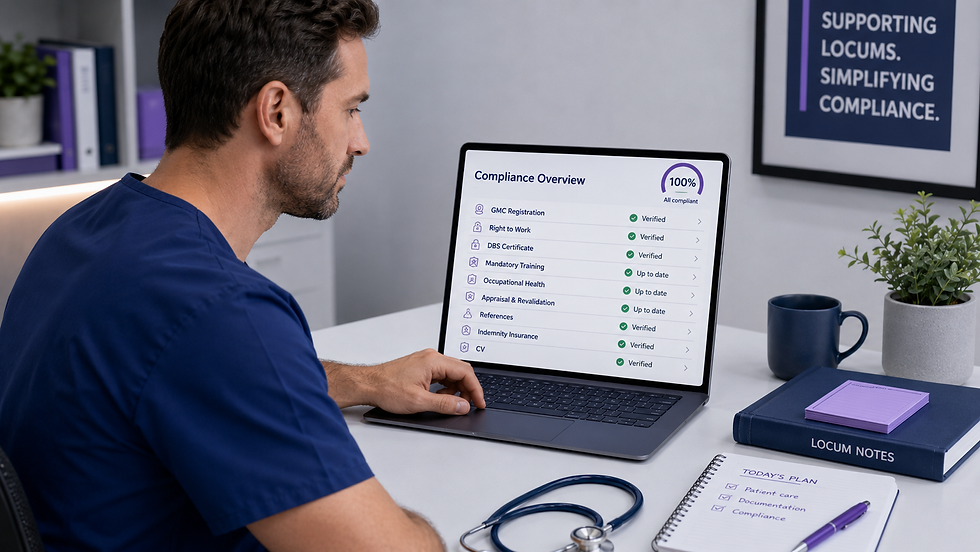
Compliance is one of the biggest practical differences between staff bank and agency work.
With an NHS staff bank, the organisation may already hold some of your employment, training and occupational health information, especially if you already work there. This can make onboarding smoother.
With agencies, you may be asked to provide a full set of compliance documents before being submitted for shifts. This can include proof of identity, right to work evidence, GMC registration details, training certificates, occupational health information, references, DBS details and other role-specific documents.
The challenge is not just having these documents. It is keeping them current, organised and ready to share.
A practical compliance checklist for locum doctors may include:
GMC registration and licence details
Proof of identity
Right to work documentation
DBS certificate details or Update Service information, where requested
Mandatory training certificates
Occupational health and immunisation evidence
Appraisal and revalidation information
References
CV
Indemnity or insurance details, where relevant
Different organisations may have different requirements, so doctors should always check what is needed before accepting a placement.
4. Career Development and Experience
Staff bank work can be helpful if you want to deepen your experience within an organisation you already know. You may build stronger relationships with local teams, understand the department better and gain continuity.
Locum agency work can be useful if you want broader exposure. Working across different hospitals or departments can help you understand different systems, patient groups, workflows and clinical cultures.
For some doctors, this variety is valuable. It can help when exploring specialties, preparing for applications or deciding what kind of working environment suits them best.
The right option depends on your career stage.
For example, a doctor who values continuity may prefer staff bank shifts. A doctor who wants broader experience or more geographical flexibility may prefer agency work.
5. Admin, Communication and Support
With a staff bank, communication may come directly from the organisation’s internal bank, the temporary staffing team, or the rota team. This can be simpler if you already know who to contact.
With an agency, the level of support can vary. A good agency can help with role matching, compliance, shift details, onboarding and communication with the hiring organisation.
However, doctors should still stay proactive. Before agreeing to a role, it is sensible to confirm:
The location
The department
The grade and expected responsibilities
Shift times
Rate and payment terms
Reporting instructions
Any required documents
Who to contact if there is an issue
Clear communication helps reduce confusion and protects your time.
Resident doctors should also check whether their employer requires them to declare or discuss additional locum work, especially where working hours, rest requirements or contractual responsibilities may apply.
Can You Use Both?
Yes, many doctors use both NHS staff banks and locum agencies.
This can be a practical approach if you want the familiarity of a staff bank but also want access to wider opportunities through agencies.
For example, you might use a staff bank for occasional shifts at an organisation you know well, while also registering with agencies to explore different locations, compare roles or increase your options during quieter periods.
The key is to stay organised. If you work through multiple routes, make sure your documents, availability, CPD records, appraisal information and shift details are easy to manage.
How Quiet Can Help Doctors Compare Their Options
Quiet is designed to make locum work easier to manage by helping doctors keep their professional information organised and ready to use.
For doctors comparing NHS staff bank vs locum agencies, this can be especially useful. Instead of repeatedly searching for certificates, updating documents or sending information manually each time an opportunity appears, Quiet helps doctors build a more portable profile.
Depending on your needs, Quiet can support you with:
Compliance document organisation
Secure document storage
One-click document sharing
Agency matching
Work Feed opportunities
Appraisal and revalidation document support
BMA Rate Card benchmarking
Quiet does not replace your responsibility to check role details, official guidance or contractual terms. Instead, it helps make the practical side of locum work clearer, calmer and easier to manage.
Which Option Is Best for Your Career?
There is no single best answer.
An NHS staff bank may be best if you value familiarity, continuity and straightforward access to shifts in an organisation you already know.
Locum agencies may be best if you want a wider choice, more flexibility, support with matching and access to opportunities across different organisations.
A combined approach may be best if you want both stability and range.
Before deciding, ask yourself:
Do I want familiar shifts or a wider variety?
Am I looking for occasional extra work or regular locum work?
Do I want to work in one organisation or compare multiple options?
How confident am I in managing compliance documents?
Do I need support finding suitable opportunities?
Am I comparing rates properly before accepting shifts?
How does this fit with my appraisal, revalidation, CPD and long-term goals?
Your answer may change over time. What suits you as a foundation doctor, resident doctor, specialty doctor, specialist, consultant, GP, or portfolio doctor may not be the same later in your career.
Key Takeaways
NHS staff banks can offer familiar, organisation-based locum work for doctors who prefer continuity.
Locum agencies may offer broader access to shifts, locations, specialties and opportunities.
Pay should be compared carefully, as rates can vary depending on role, urgency, location, grade and terms.
NHS agency price caps may apply to agency work and are maximum rates, not guaranteed rates.
Compliance is easier to manage when your documents are organised, current and portable.
Many doctors use both staff banks and agencies, depending on their goals and availability.
Always check the latest official guidance for pay, tax, pensions, GMC requirements, NHS policies and contractual terms.
Further Reading
You may also find these Quiet guides useful:
Whether you are considering an NHS staff bank, registering with locum agencies, or using both, Quiet can help you compare your options with more clarity.
Explore Quiet to organise your documents, review opportunities and take the next step in your locum career with confidence.


Comments